
Combat system, mechanic by mechanic
Machine guns build scratch damage that cannot kill; handguns and grenades convert it into direct damage that can. Bezels pay for Hero Actions.
Resonance of Fate's battle system is the reason the game still gets argued about. It is not turn-based and it is not an action game: you spend action points moving in real time, then commit to a charged shot that resolves on its own. Most of the difficulty in the first five hours comes from not knowing which half of that sentence is doing the work.
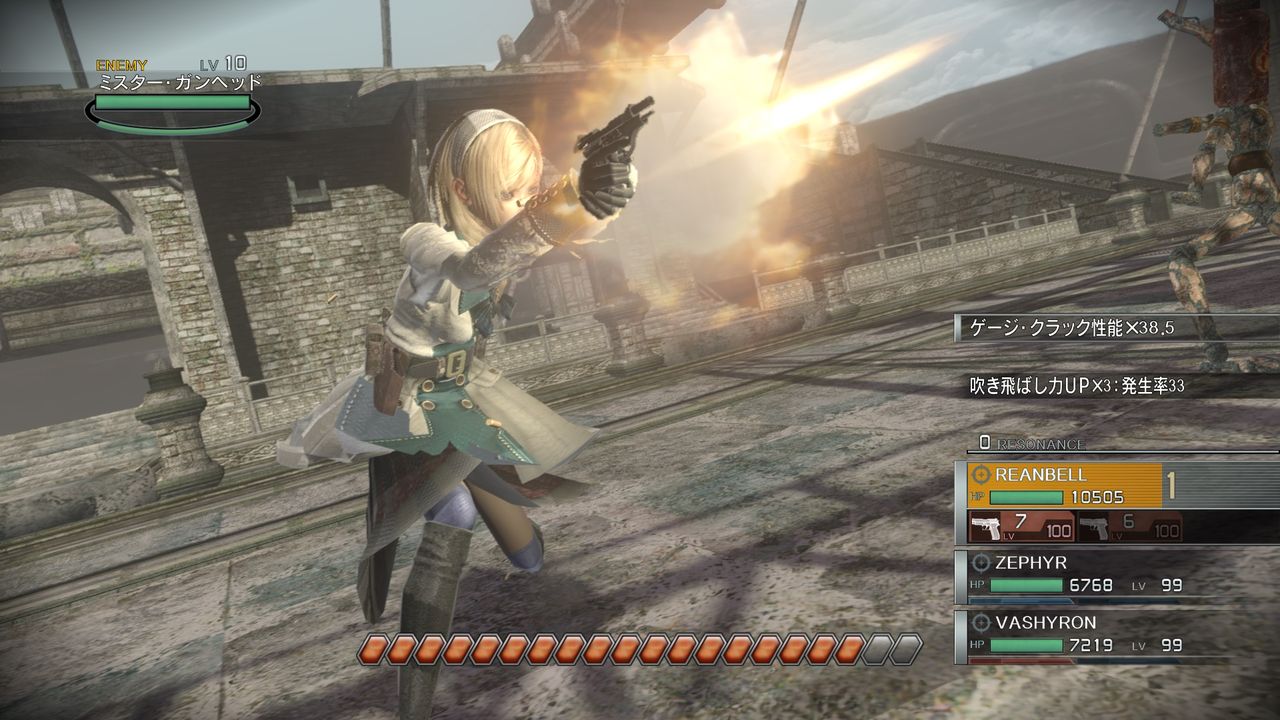
The core loop in one table
| Mechanic | How it works |
|---|---|
| Action points | Each character's turn is limited by action points; movement and weapon switching consume them |
| One attack per turn | You may only make a single attack in a turn, and the turn ends after it even with points left |
| Charging | Select a target and the attack charges; it fires when the charge meter fills |
| Multiple charges | Charging more than once produces a stronger attack at the cost of more time |
| Charge time vs distance | The closer the target, the faster the charge, and the more exposed you are |
| Scratch damage | Machine guns deal scratch damage, which accumulates fast but cannot kill |
| Direct damage | Handguns and grenades convert scratch damage into direct damage, which can kill |
| Hero gauge and Bezels | Bezels are the currency for Hero Actions, earned by gauge breaking and by kills |
| Hero Actions | Run a preset path while time slows and charge speed rises; costs Bezels |
| Bonus Shots and Smackdown | Airborne follow-ups and knockdown attacks that finish a launched enemy |
| Tri-Attack | A three-character attack taught by the in-game tutorial; the Tri-Attacker achievement fires on your first one |
| Gauge breaking | Breaking an enemy's HP gauge is both a damage route and a Bezels source |
| Body parts | Enemies have destructible parts, and destroying them is how a lot of item drops appear |
Why scratch damage is the whole game
Machine guns cannot kill anything. They fill an enemy's scratch meter, which is a stored damage value waiting to be converted. A handgun or grenade hit converts the stored scratch into direct damage, and that is what removes the health bar.
This produces the single most common beginner mistake: firing a machine gun until it is empty and wondering why the enemy is still standing. The correct rhythm is short machine-gun bursts to build scratch, then a handgun shot to cash it in. Once that clicks, the difficulty curve flattens noticeably.
It also explains why the achievement list has separate gun-based milestones. Bullet Barrage asks for a 500-hit combo, which is a machine-gun exercise; Big Shot asks for 2000 damage in one attack, which is a converted-scratch handgun exercise.
Bezels and Hero Actions
Hero Actions are the game's showpiece: you draw a path for a character, they run it while the world slows, and charge speed goes up. The cost is Bezels. You earn Bezels by breaking enemy gauges and by killing enemies, and the gauge you break is also the gauge that gates an enemy's defences.
The practical consequence is that Hero Actions are not free spectacle, they are a resource loop. Spending all your Bezels on a trash encounter leaves you without the slow-time advantage on the boss two rooms later. Most experienced play is about banking Bezels on easy fights and spending them where charge time would otherwise kill you.
Position, distance and danger
Charge time scales with distance: stand next to an enemy and the shot charges fast, but you eat the counterattack; stand far away and you charge slowly while the enemy closes. Hero Action paths exist to break that trade-off, because the path can carry you past the enemy while the shot charges.
Enemies also move while you move, and they tend to focus the character you are currently controlling. That is why switching characters mid-fight is a defensive tool, not just a way to spread damage.
Equipment you actually need equipped
Items are not usable from a menu by default. You equip a First Aid Kit to use healing items, a Grenade Box to throw attack items, and a Magazine Case to load specialty rounds. Characters without the case cannot fire elemental ammunition, which is why the early game feels like it is missing options you can see in the shop.
Each of those is a slot you are not spending on stats. The trade is deliberate, and it is why weight and loadout planning matter as much as raw attack power — see gun customization and character builds.
Status, elements and critical condition
Elemental rounds, status ailments and critical condition are all part of the system, but they are secondary to the scratch-and-convert loop. Critical condition changes how a character behaves when their gauge is low, and it interacts with rate of fire. Treat elemental ammo as a tool against specific enemies rather than a general upgrade.
Learning it properly
The game has a tutorial set — 16 lessons covering charging, scratch damage, the hero gauge, Hero Actions, the Tri-Attack, magazine cases, body parts, gauge breaking, multiple charges, bonus shots and smackdown. They are available from the Arena from the start of chapter 1 and are the same lessons as the manual. Skipping them is the single biggest cause of bouncing off the game.
Mechanics: in-game manual text and battle-system notes as documented on the Resonance of Fate wiki, plus the Steam store description; checked 2026-10-31.