
Beginner guide: the first five hours
Burst with the machine gun to build scratch, convert with the handgun to kill, bank Bezels on trash fights, and do the 16 Arena tutorials before chapter 2.
The first five hours of Resonance of Fate are the hardest part of the game, and they are hard for a specific reason: the game gives you a machine gun, a handgun and a resource system, then lets you lose for a while before explaining any of it. This page is the explanation.
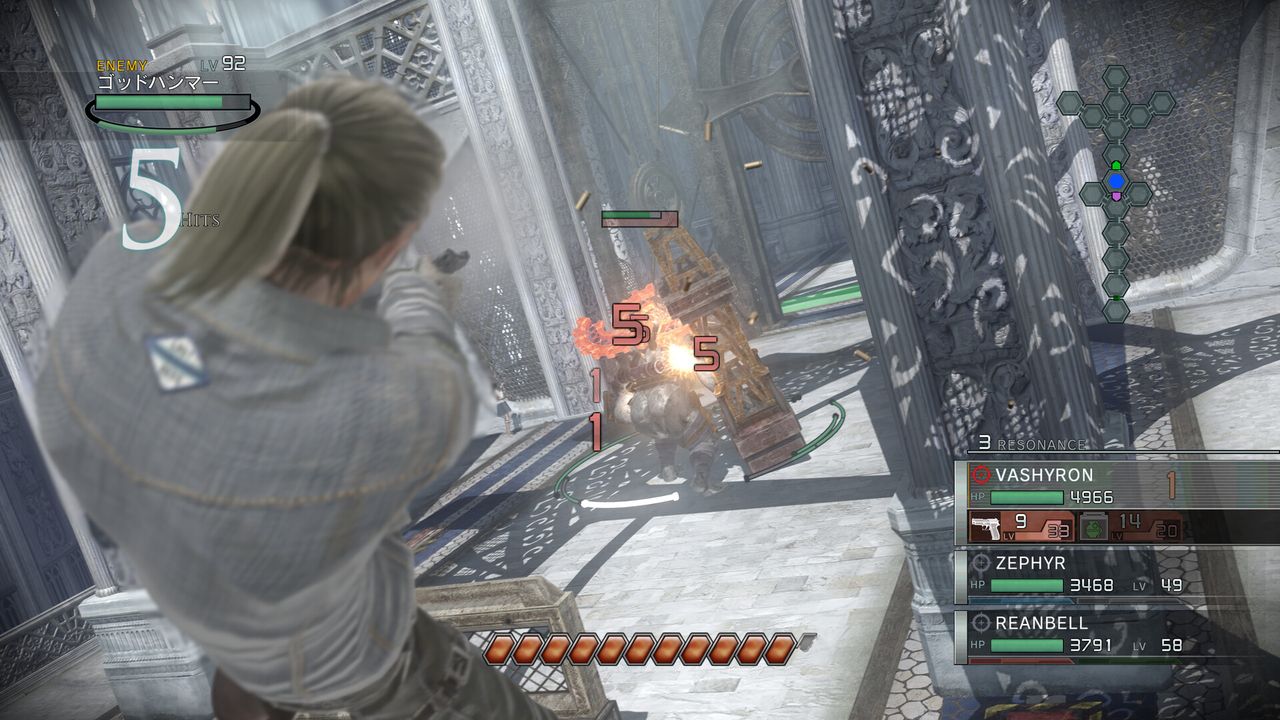
Five habits that stop the early collapse
- Never empty a machine gun into a full health bar. Scratch damage does not kill. Burst to build scratch, then convert with a handgun or grenade.
- Read charge time before you commit. A long charge at range means the enemy closes, hits you, and interrupts. Move closer or use a Hero Action.
- Bank Bezels on trash fights. You earn them by breaking gauges and killing; spend them on bosses, not on the third random encounter.
- Do the Arena tutorials before chapter 2. Sixteen lessons, available from chapter 1, and they cover exactly the mechanics the story does not.
- Switch characters when you are being focused. Enemies attack whoever you control; switching moves the aggro.
The first hour, in order
| Step | What to do | Why |
|---|---|---|
| 1 | Leave the base and talk to the staffer outside the guild | Unlocks the bulletin board and your first side missions |
| 2 | Check the board before every story mission | Side missions expire when you advance chapters |
| 3 | Do the Arena tutorial set | It covers charging, scratch damage, Hero Actions and Tri-Attacks |
| 4 | Learn the map hex basics | You cannot reach most missions until you place energy hexes |
| 5 | Buy a Magazine Case as soon as it is affordable | Unlocks elemental rounds for the character carrying it |
Money and points in the early game
Two currencies matter. Rubies are money and buy weapons, parts, clothing and Arena entries. Hunter Points are reputation, paid out by missions, and they are what gates progression through the guild's mission list.
The prologue mission alone pays 25 Hunter Points and 25,000 rubies, which is enough to stop you feeling poor for the first two chapters. Side missions pay smaller amounts but often include a custom part, and custom parts are the expensive part of the game — a single sight can cost 3,000 rubies while a side mission hands you one for free.
The chapter 1 wall
Chapter 1 sends you to Lucia to place a flower on a grave, which sounds calm and is not: the dungeon is multi-area, the encounters are denser than the prologue, and the chapter's boss is the first real check on whether you understand scratch damage.
If you are losing there, the fix is almost always the same: stop treating the machine gun as a damage weapon, start converting scratch with the handgun, and use a Hero Action to close distance instead of walking. Levels help, but they are not the missing piece at this point.
What to ignore for now
- Gun customization beyond a sight and a barrel. You cannot afford the good parts yet and the weight limits early characters are tight.
- The Arena ranks past the first few. Entry costs scale and the rewards are aimed at players who already have a build.
- Green and black hexes. You will not have them yet, and they are not needed for the main route.
- Perfect side-mission clears. Do the ones that pay custom parts; let the rest go if a chapter is about to end.
When it starts to click
Around chapter 5 or 6 the game stops feeling unfair. By then you have a second weapon per character, a custom sight, a magazine case and enough Bezels to use Hero Actions on bosses. The chapters after that are still hard, but they are hard in a way you can plan for — which is the real difference between chapter 2 and chapter 10.
Where to read next
Combat system for the mechanics in one table, gun customization once you can afford parts, character builds for who should carry what, and side missions so you stop losing optional content to chapter transitions.
Sources: in-game manual lessons via the Arena tutorial set, mission rewards from the community chapter documentation, checked 2026-10-31.